"Constructing Carmichael numbers through improved subset-product algorithms," co-authored with the late Red Alford, as well as Steven Hayman and Andrew Shallue, has been published on-line by Mathematics of Computation.
It looks like all of the 2013 issues of Math. Comp. are filled up, so this will probably be officially a 2014 paper once it appears in print.
As this is my first co-authored paper to be published, I now have a finite Erdős number, namely 3. (Red co-authored with Carl Pomerance and Andrew Granville, who each have an Erdős number of 1.)
(According to MathSciNet, this reduces Shallue's number from 4 to 3, and is Hayman's first paper. This paper, however, is not indexed by MathSciNet yet, which limits my ability to compute some collaboration distances that interest me, as well as raising the possibility that my co-authors have other un-indexed papers.)
I lost my chance at an Erdős number of 1 by deflecting his questions about what I was working on, but, well, I'm not really into Erdős-style collaborations, and I'm comfortable with my style of research.
Tuesday, July 16, 2013

Friday, April 12, 2013
SERMON 2013 Talk
I am scheduled to give a talk at the SERMON 2013 conference entitled "Collecting primes with p2-1 1163-smooth, or reduced sets for likely solutions to the $620 problem." It is an update to my 2005 talk.
Here are the slides.
Here are the slides.
Monday, August 20, 2012
Repeatedly Appending Digits and Only Finding Composites
I have uploaded slides for my talk at next month's PANTS meeting. The title is "Repeatedly Appending Digits and Only Finding Composites". It is based on joint work with Witold Jarnicki, John Rickert, and Stan Wagon. You can find the paper at Stan's site.
Monday, April 02, 2012
Constructing Carmichael numbers through improved subset-product algorithms
A pre-print of "Constructing Carmichael numbers through improved subset-product algorithms" is now available at the math arXiv. The paper contains research Red Alford and I did. It also contains research by our co-authors, Steven Hayman and Andrew Shallue, who have some impressive constructions and interesting algorithms. I hope to modify the code they wrote to expand the computations of Carmichael numbers with exactly k factors, which was done on a computer that is now outdated.
Wednesday, December 07, 2011
Google Scholar
I went ahead and claimed my Google Scholar page. I trimmed two articles that I didn't actually write. It claims that I have been cited 85 times, including 33 times in the past 5 years. Perhaps most amusing to me is my work being cited in US Patent #7181017. I'm not actually a fan of patenting algorithms, but I'm glad people are reading my work.
Tuesday, May 03, 2011
My first Math Reviews byline
 Last year, I signed up to be a reviewer for Mathematical Reviews. For those of you not familiar with the publication, it is essentially a database of mathematics articles, with short "reviews" written by other mathematicians. These are not reviews in the ordinary sense of a book or movie review -- the reviewer usually doesn't venture an opinion of the work, and even more rarely expresses a negative one. Rather, the review summarizes the results and attempts to put them into context.
Since 1940, Math Reviews has provided an invaluable service for research mathematicians -- having a good summary of an article is important before one begins the arduous task of tracking down a journal article, and the sometimes more arduous task of reading it. This utility has only increased with the electronic form of the database.
My first review appeared this year, and is of the article "On congruence conditions for primality" in the journal Integers. I think you can access the review here if your institution subscribes, but for various uninteresting reasons, I can't confirm that.
Anyway, I'm particularly proud of my five sentences because I have been a Math Reviews reader for about twenty years, and it is nice to join the ranks of the reviewers. Also, I think I get a discount on my next year's AMS membership.
Tuesday, March 22, 2011
Letter to the Editor
Stan Wagon wrote a letter to the editor in the April 2011 Mathematics Magazine about Perrin's sequence and Perrin pseudoprimes. You may not be able to access it on-line (I can't), but it reads in part:
An important question is: Is an integer prime if and only if it satisfies the Perrin condition, n divides xn ? This question was raised by R. Perrin in 1899. A counterexample, now known as a Perrin pseudoprime, was not discovered until 1982: the smallest one is 271441. This is quite remarkable compared to, say, Fermat pseudoprimes with base 2, for which 341 is the smallest example. Recent work by J. Grantham [3] shows that there are infinitely many Perrin pseudoprimes.It's always gratifying to see one's work referenced, and the letter provides some nice context for my research (better than I did in the paper itself!).
Monday, November 15, 2010
John Selfridge, 1927-2010
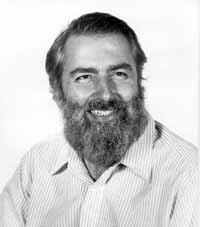
Along with Pomerance and Wagstaff, he is the originator of what has come to be known as "the $620 problem", the question of whether there is a number which is simultaneously a strong pseudoprime to the base 2 and a Lucas pseudoprime. If the answer is yes, he promised to pay $500 for the solution, with Wagstaff paying $100 and Pomerance $20. If the answer is confirmed as no, Selfridge would be on the hook for $20, Wagstaff $100 and Pomerance $500.
When asked why he would volunteer higher amount upon production of a counterexample -- which almost surely exists -- he explained that if someone produced a dense proof claiming to show that none existed, he would rather Pomerance -- with $500 on the line -- have to read through the proof to find an error. The counterexample, on the other hand, would be easy to verify or dismiss.
Throughout the '90s, and even into this century as his health was failing, I ran into Selfridge at practically every number theory conference I attended. Having retired, he enjoyed nothing better than traveling around, listening to mathematics talks, and enjoying the social company of mathematicians (with the associated libations). Having invested well, he decided he would rather the money go to mathematics than to the government through taxes, so he set up the Number Theory Foundation, which helps fund many of the conferences he enjoyed.
Rest in Peace, John Selfridge. You will be missed.
Thursday, September 16, 2010
Le plus grand facteur premier de la fonction de Landau
A preprint appeared on the math arXiv this week entitled, "Le plus grand facteur premier de la fonction de Landau." I think that translates as, "The largest prime factor of Landau's function." Landau's function is the maximal order of Sn (the symmetric group on n elements). The first paper I ever published was The Largest Prime Divisor of the Maximal Order of an Element of Sn.
So this new paper is interesting to me. My paper is reference 7. I'm mentioned 3 times in the body of the text. Here are the mentions, as rendered by Google Translate:
I think the last one needs a little work. I'll have to sit down when I have time to read a 40-page paper in French and figure out what's going on.
But anyway, not only do I have a problem, I also have a method. Cool.
So this new paper is interesting to me. My paper is reference 7. I'm mentioned 3 times in the body of the text. Here are the mentions, as rendered by Google Translate:
- This increase was enhanced by Grantham
- For this we use the method of Grantham
- In the proof of the theorem of [7], α1 suites. . . , Α9, β1,. . . , Used β9 J. Grantham are very similar to those obtained by Algorithm 1 y = 3329.
I think the last one needs a little work. I'll have to sit down when I have time to read a 40-page paper in French and figure out what's going on.
But anyway, not only do I have a problem, I also have a method. Cool.
Tuesday, August 24, 2010
Carmichael Numbers with Exactly k Prime Factors
One of my projects for this year is to finish a paper that Red Alford and I started where we show the existence of Carmichael numbers with exactly k prime factors for a wide range of k. Red passed away 7 years ago, so I think it's about time I get this paper out of the door.
One of my problems has been with the complexity of the code needed to finish the computation. Recently I've been teaching myself Python, which looks like it can cut through some of the complexity issues for the less computationally-intensive parts of the computation.
Anyway, I recently received a request for information about the technique Red and I used. I realized that I never put any of my talks about this technique on-line, so I uploaded a talk I gave in 2003 at the Hugh Williams conference in Banff.
One of my problems has been with the complexity of the code needed to finish the computation. Recently I've been teaching myself Python, which looks like it can cut through some of the complexity issues for the less computationally-intensive parts of the computation.
Anyway, I recently received a request for information about the technique Red and I used. I realized that I never put any of my talks about this technique on-line, so I uploaded a talk I gave in 2003 at the Hugh Williams conference in Banff.
Sunday, March 21, 2010
Online publication
My article on the infinitude of Perrin pseudoprimes has now been published on-line. Paper publication to follow.
"Please note access to the full text of this article will depend on your personal or institutional entitlements."
Friday, March 12, 2010
Now, with keywords!
The Journal of Number theory has asked me to add keywords to the paper. I also added them to my own copy, the updated version of which is available on Google Docs.
Thursday, March 04, 2010
This blog has moved
This blog is now located at http://math.pseudoprime.com/.
You will be automatically redirected in 30 seconds, or you may click here.
For feed subscribers, please update your feed subscriptions to
http://www.pseudoprime.com/pseudo/atom.xml.
Saturday, February 20, 2010
Yet another new version of the paper
I got the proofs back from the Journal of Number Theory, and they made a few minor changes (mostly capitalization and such). I'm having trouble ftp'ing to pseudoprime.com, so you can find the latest versions here on Google Docs.
Thursday, November 12, 2009
Even newer version of paper!
The referee had 9 additional suggestions after receiving my previous revision. I incorporated 8 of them, and the paper has now officially been accepted by the Journal of Number Theory. The latest version is here.
Thursday, October 22, 2009
Elliptic Pseudoprimes
Mathematics of Computation recently published an article by Siguna Müller entitled, "On the existence and non-existence of elliptic pseudoprimes". She refers to two of my papers (references [7] and [8]).

I have not looked much at elliptic pseudoprimes. In particular, in my 2001 paper, "Frobenius Pseudoprimes", I say,
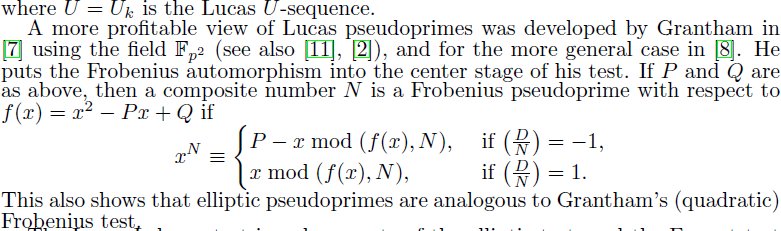
I have not looked much at elliptic pseudoprimes. In particular, in my 2001 paper, "Frobenius Pseudoprimes", I say,
This paper does not pretend to be an exhaustive treatment of all notions of pseudoprimality. For example, nothing is said about elliptic pseudoprimes [8].Maybe I should look at them some more.
Tuesday, September 29, 2009
Newer version of paper!
I have incorporated the referee's 44 suggestions and made other changes. The newest version of the paper is available here. The editor is sending it back to the referee. Hopefully this merry-go-round will stop soon!
Wednesday, September 02, 2009
Grantham's Problem
While reviewing the referee's 44 (sigh) suggested changes to my paper, I came across an article published last November entitled "Inefficacious Conditions of the Frobenius Primality Test and Grantham's Problem".
I have a problem named after me!
So the next time someone asks me, "What's your problem?" I can say, "Are there any composite numbers n ≡ ±2 (mod 5) such that x^(n+1) ≡ 5 (mod(n, x^2 + 5x + 5))?"
I have a problem named after me!
So the next time someone asks me, "What's your problem?" I can say, "Are there any composite numbers n ≡ ±2 (mod 5) such that x^(n+1) ≡ 5 (mod(n, x^2 + 5x + 5))?"
Monday, March 23, 2009
New Version of Paper
Well, this time I didn't take 6 or 7 years. After slightly more than two years, I've revised There Are Infinitely Many Perrin Pseudoprimes again. I used a more modern version of the journal's style guide, and I incorporated some comments an editor suggested. Now hopefully it'll go off to another editor (don't ask) and a referee!
Monday, December 11, 2006
Things Have Changed
Since I last submitted that paper.
Still, the "rejection" was very encouraging, saying
- The journal that had been interested in publishing it no longer publishes things on that subject.
- A paper can be turned down in 2 days.
Still, the "rejection" was very encouraging, saying
I would urge the author to submit his paper to a top-end number theory journal...So I will, but I have to do some further (minor) reformatting.
Subscribe to:
Posts (Atom)